What Is Solution-Focused Health Coaching?
Stamina Lab trains health and performance professionals in the evidence-based Solution-Focused approach, a disciplined conversational approach that improves engagement, follow-through, and measurable outcomes.
What Is Solution-Focused Health Coaching?
Solution-Focused health coaching uses an evidence-based approach to behavior change, starting with the client's preferred future rather than the problem. The practitioner invites the client to describe that future, the steps they would have taken to get there, what's already working, and the immediate next step that increases the likelihood of progress.
Why Most Behavior-Change Conversations Fall Short
Most professionals are trained to start conversations by identifying the problem, what's wrong, what isn't working, what needs to change. It's logical, and it's the standard in clinical education.
But decades of research show that problem-focused conversations tend to produce insight without progress. They can inadvertently reinforce helplessness, shift responsibility for change onto the professional, and contribute to disengagement.
Start with what's wrong
Assess the problem. Identify barriers. Explain risks. Offer a plan. Hope the patient follows through.
- Amplifies deficits and failures
- Can induce shame, guilt, or defensiveness
- Defines the professional as the source of solutions
- Produces insight and plans, but not necessarily progress
Start with what's wanted and working
Help the patient describe their preferred future, surface what's already contributing to progress, and define observable signs of near-term progress and an immediate next step.
This kind of future-focused conversation invites mental rehearsal and helps prime neural pathways for action.
- Builds on existing competence and successes
- Increases hope, confidence, and self-efficacy
- Positions the patient as the agent of their own change
- Produces engagement, ownership, and follow-through
The Dialogic Orientation Quadrant (DOQ)
A core tool you'll learn how to use is the DOQ, a practical framework that helps professionals track where a conversation is in real time and respond in ways that consistently move it toward progress.
The DOQ maps every moment of a conversation along two dimensions: time orientation (past vs. future) and focus (problems vs. goals). This gives practitioners a reliable way to listen, orient, and respond, even in brief or complex interactions.
Conversations that stay "above the line" are grounded in the patient's resourceful past and hopeful future, which produces measurably better outcomes faster: stronger patient engagement, clearer next steps, and higher follow-through.
The DOQ is not a script. It's a navigational tool that sharpens clinical judgment and makes every conversation more purposefully, without adding time, more effort, or complexity to your workflow.
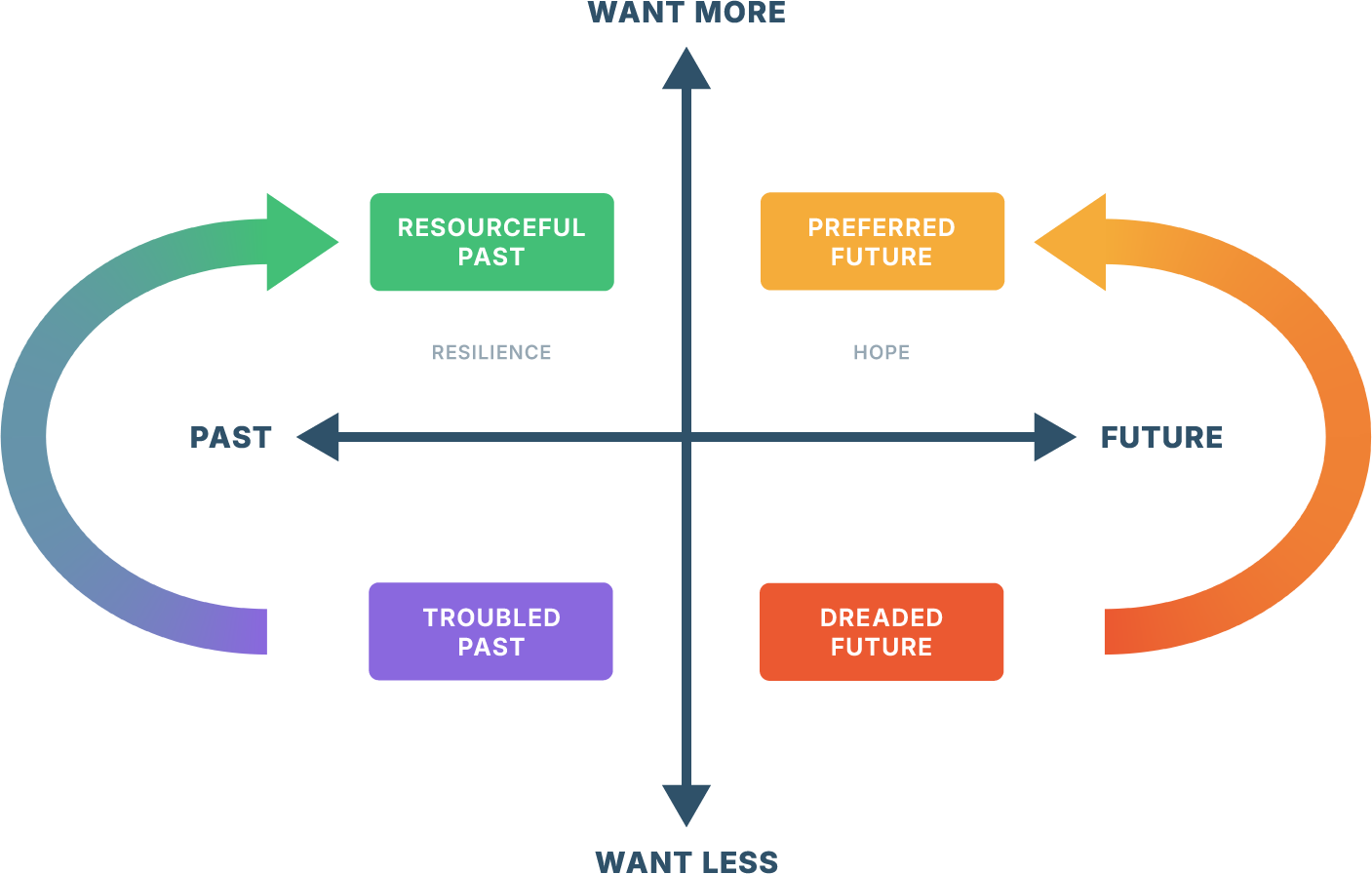
Graphic adapted from Haesun Moon (2021)
The Three-Part Solution-Focused Structure
Solution-Focused conversations follow a consistent, repeatable structure that works whether it's 5-minute check-ins or 30+-minute consults. Professionals learn to guide every interaction through the three parts:
What's Wanted
Help the patient or client define their preferred future in concrete, personal, observable terms, what life looks like when things are better, and the difference it will make for them and the people in their lives.
What's Working
Surface exceptions, successes, and evidence of progress that already exist, often invisible to the patient until the conversation helps reveal them.
What's Next
Help the patient with small, observable, near-term next steps, grounded in the patient's own language and connected to the future they described, that make follow-through a natural extension of the conversation.
Built on a Substantial Evidence Base
The Solution-Focused approach is supported by multiple systematic reviews, meta-analyses, and randomized controlled trials across clinical, behavioral, and organizational settings.
Engagement & Adherence
Research demonstrates that solution-focused conversations increase patient engagement, treatment adherence, and self-reported well-being across chronic conditions including diabetes, cardiovascular disease, and mental health.
Self-Efficacy & Agency
Solution-focused interactions strengthen internal locus of control, self-efficacy, and agency, consistently identified in the literature as the strongest predictors of positive health outcomes and sustained behavior change.
Communication Quality
Systematic reviews show that clinician communication directly affects adherence, self-management, and health outcomes, yet many conversations leave little room for the patient's voice, priorities, and lived reality to shape what happens next.
A Stance, Not Simply a Technique
The Solution-Focused approach is more than a set of questions or a conversational script. It is a disciplined professional stance, a way of thinking and orienting to people that presupposes competence, surfaces what's working, and consistently anchors conversations in the direction of the patient's preferred future.
This stance holds across contexts: a 5-minute clinical check-in, a coaching intake, a leadership conversation, or a complex care planning discussion. It doesn't replace clinical expertise, it makes that expertise more effective by ensuring the conversation creates the conditions for follow-through.
Professionals trained in this approach consistently report that conversations become more time-efficient, patients become more engaged, and the professional burden of "convincing" or "motivating" people to change is replaced by a collaborative process where patients own their own solutions and progress.
Frequently Asked Questions
Solution-Focused health coaching uses an evidence-based approach to behavior change that builds conversations around the client's preferred future, what's already working, and the immediate next step. Rather than analyzing what's wrong, the practitioner invites the client to describe the future they want, the steps they would have taken to get there, and what's already working.
Yes. The Solution-Focused approach is evidence-based, established through results from research in mental and behavioral health, including over 200 studies, eight meta-analyses, and systematic reviews on behavior change outcomes for anxiety, depression, substance use, and related concerns. The approach also has a solid research base in education and social services, and has been applied more broadly in organizational and criminal justice settings. The references at the end of this page list key studies.
Traditional coaching typically starts by identifying problems, analyzing barriers, and prescribing corrections. Solution-Focused coaching starts somewhere else: the practitioner's main work is formulating questions that presuppose the client's preferred future has already happened, and invite the client to describe it: what they'd be doing, who would notice, how they got there, in the context of their actual daily life. Those questions are the intervention: each helps the client to think in new ways, problem-analysis tends to close down, discovering possibilities and options they hadn't considered. From there, the conversation moves to what's already working and an immediate next step, one the client generates and owns, which supports follow-through even in the presence of ongoing challenges.
Both are evidence-based approaches used in health conversations, and both are goal-oriented. The difference is in direction and starting premise. Motivational Interviewing assumes the client is ambivalent, and works to strengthen motivation by resolving that ambivalence, moving from the present toward a goal. Solution-Focused practice assumes the client is already motivated, and works backward from the future the client wants, as if it has already become their reality, helping the client describe that future and what they would have done to get there. Solution-Focused conversations also locate change within the client's actual daily life: not as an abstraction, but in the context of their day-to-day relationships and routines. Research suggests the two approaches are similarly effective, with Solution-Focused practice tending to work faster and require fewer sessions. For a detailed comparison, see Solution-Focused vs. Motivational Interviewing.
The two address different aspects of behavior and behavior change.
Habit coaching helps clients build a stable link between a cue and a behavior, repeated until the behavior happens with little conscious thought. Flossing after brushing teeth is a classic example: brushing becomes the cue for flossing, and over time the behavior needs less and less conscious thought.
Solution-Focused coaching looks at behavior change differently. Whether the client is working on one behavior or many, that behavior is always situated in the context of the future they want to be living. The practitioner helps the client develop a detailed description of that better future that includes when, where, and how the behavior happens, who's around, what helps make it possible, and what the behavior means, to the client and people important to them. Change isn't isolated to a single repeated action; it's connected to how the client will be living in their better future, and the person they would have become.
The reliance on a stable cue creates a real difference between the two approaches. Habit coaching depends on that stable cue since it's the cue that triggers the behavior. It must stay consistent to keep the habit running. That reliance makes habits fragile: when life changes, the cue can disappear, and the habit breaks down with it. Solution-Focused coaching doesn't depend on a fixed cue at all. It's built to work with a changing context from the start, since it's the better future the client is working toward, and the person they're becoming within it, that anchors the behavior.
Stamina Lab's certification, Foundations in Solution-Focused Health Coaching, trains health and performance professionals in the approach. The course is approved for 6.0 AMA PRA Category 1 Credits through Indiana University School of Medicine and 0.70 ACE CECs, and combines self-paced learning with live one-on-one case consults.
Gain Solution-Focused Skills That Make a Difference
Foundations in Solution-Focused Health Coaching is a self-paced certification, approved for CME and ACE credit, that gives health and performance professionals a structured, immediately applicable approach to creating conversations that produce the outcomes that count, with AI-powered practice and expert assessment.
6.0 AMA PRA Category 1 Credits™ · 0.70 ACE CECs · Indiana University School of Medicine · 30-day satisfaction guarantee
Dr. Deborah Teplow
Co-Founder & Chief Program Architect, Stamina Lab
Dr. Teplow earned her doctorate from Stanford University and has spent decades translating behavior-change science into structured professional practice. She was introduced to Solution-Focused brief therapy by its creators, Steve de Shazer and Insoo Kim Berg, and has completed advanced practitioner and supervisor training with BRIEF, Elliott Connie, Adam Froerer, Teri Pichot, Linda Metcalf, and Dr. Jacqui von Cziffra-Bergs.
Dr. Teplow co-founded the Institute for Wellness Education, where she and co-founder David Mee-Lee created the U.S. national occupational standards and training curriculum for the Department of Labor's Registered Apprenticeship in Wellness Coaching. She has trained practitioners for organizations including Healthy Start (HRSA/HHS), Blue Cross Blue Shield of North Dakota, the Los Angeles County Department of Public Health, and Medica.
She is a long-standing educational partner with Indiana University School of Medicine, where she has developed CME programming across major medical specialties. She leads all faculty development and program quality at Stamina Lab.
References
Abdulla, A. (2024). Solution-Focused scaling questions: Time taken, words written, expectancy and commitment. International Journal of Coaching Psychology, 5(3), 1–15.
Gong, H., & Xu, W. (2015). A meta-analysis on the effectiveness of solution-focused brief therapy. Studies of Psychology and Behavior, 13, 799–803.
Grant, A., & Gerrard, B. (2019). Comparing problem-focused, solution-focused and combined problem-focused/solution-focused coaching approach: Solution-focused coaching questions mitigate the negative impact of dysfunctional attitudes. Coaching: An International Journal of Theory, Research and Practice, 13, 1–17.
Grant, A. M., & O'Connor, S. A. (2018). Broadening and building solution-focused coaching: Feeling good is not enough. Coaching: An International Journal of Theory, Research and Practice.
Jordan, S. S. (2014). Asking different questions: Validation of the solution building inventory in a clinical sample. Journal of Systemic Therapies, 33(1), 78–88.
Jordan, S. S., Froerer, A. S., & Bavelas, J. B. (2013). Microanalysis of positive and negative content in solution-focused brief therapy and cognitive behavioral therapy expert sessions. Journal of Systemic Therapies, 32(2), 46–59.
Kim, J. S., Smock, S., Trepper, T., McCollum, E., & Franklin, C. (2010). Is solution-focused brief therapy evidence-based? Families in Society, 91, 300–306.
Kitai, A., Shimada, Y., Tagoo, M., & Otomo, M. (2023). Can a solution-focused coaching approach go beyond the ocean and campus? Comparing solution and problem-focused approaches for Japanese students and business people. Journal of Solution Focused Practices, 7(1).
Korman, H., Bavelas, J. B., & De Jong, P. (2013). Microanalysis of formulations in solution-focused brief therapy, cognitive behavioral therapy, and motivational interviewing. Journal of Systemic Therapies, 32(3), 31–45.
Moon, H. (2021). Efficacy of training in solution-focused coaching: Process study of learners' progress in response choices (Doctoral dissertation).
Richmond, C. J., Jordan, S. S., Bischof, G. H., & Sauer, E. M. (2014). Effects of solution-focused versus problem-focused intake questions on pre-treatment change. Journal of Systemic Therapies, 33(1), 33–47.
Solms, L., Koen, J., van Vianen, A. E. M., Theeboom, T., Beersma, B., de Pagter, A. P. J., & de Hoog, M. (2022). Simply effective? The differential effects of solution-focused and problem-focused coaching questions in a self-coaching writing exercise. Frontiers in Psychology, 13, 895439.
Zhang, A., Franklin, C., Currin-McCulloch, J., Park, S., & Kim, J. (2018). The effectiveness of strength-based, solution-focused brief therapy in medical settings: A systematic review and meta-analysis of randomized controlled trials. Journal of Behavioral Medicine, 41, 139–151.