Suppose your most committed client left your session with a plan for moving toward their goals. And sometime later, conditions changed or a bump in the road popped up, but your client was still able to stick to the plan. What would have made the difference?
What wouldn't have made the difference is more motivation. They already had that when they made the appointment to work with you. And almost every client who walks away with a plan would say they're motivated.
But one of the most common (age-old) questions coaches ask is how to get people to follow through on what they've said they'd do. Dr. Deborah Teplow, our co-founder, puts the honest answer plainly: "You can't get or make people do anything. But you can facilitate behavior change so it's more likely to happen. After all, isn't that what coaching is all about?"
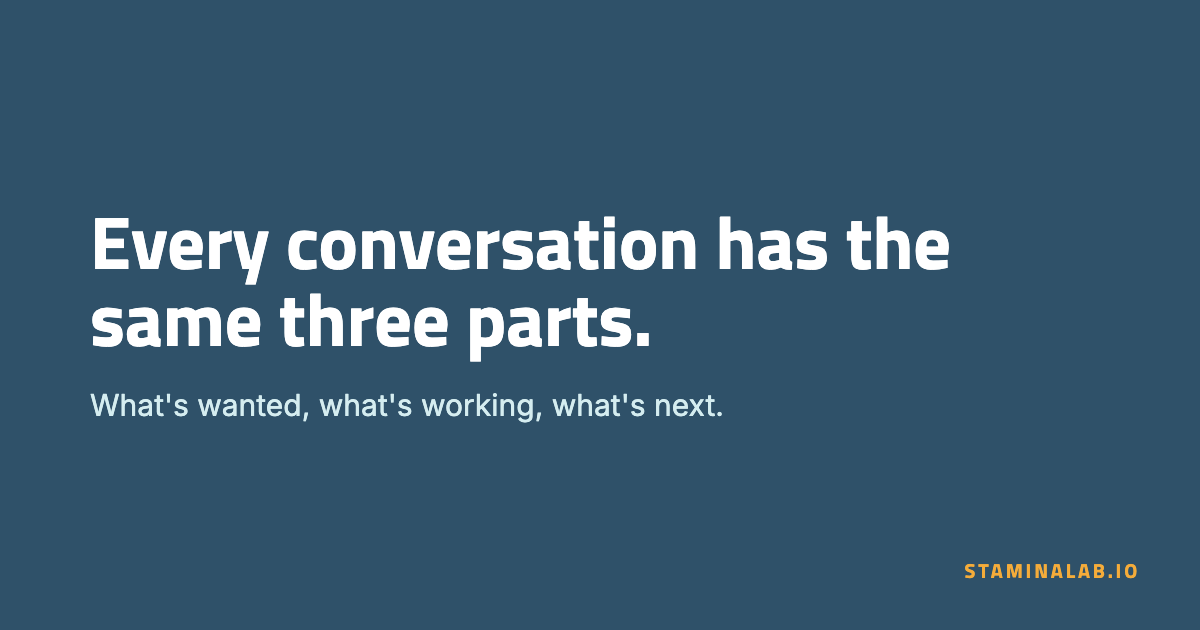
So if follow-through can't be commanded, and motivation was already present, what actually builds it? The answer is structural. It lives in how the conversation itself is put together. This post lays out the whole argument. Over the next eight weeks we'll unpack each piece in its own article.
Motivation was never the missing piece
Most coaching approaches treat motivation as the variable to work on because it's seen as what's lacking. Motivational Interviewing, the most widely taught of conversational helping approaches, is defined by its developers as a way of talking with people about change that strengthens their own motivation and commitment. It was developed to address the ambivalence that commonly stalls behavior change, and it's good at that job.
Solution-Focused practice starts from a different place. In Deborah's words from a recent talk to nutrition coaches:
"Clients are motivated for something or they wouldn't be talking to you. Your job isn't to assess or increase motivation. It's to help clients build a vision of the future they want, which is motivational in itself."
Even a client who shows up because someone else wanted them to is still motivated for something. "Maybe not for what you expect," Deborah notes, "but motivation is already present. It's up to you to help the client apply it."
She goes on to point out that MI's four types of preparatory change talk, desire, ability, reasons, and need, are what the coach is expected to draw out from a client, one element at a time. Solution-Focused practice has no equivalent to those four elements: it moves straight to what the client wants and what's already working, without needing to establish anything first.
Same person, same things they want to change in their lives. In Deborah's words: "Depending on which door you walk through, you're asking completely different questions from the very first moment. And that's not a small technical difference. It changes every comment you make, every question you ask after that. It changes what you're listening for, it changes what you respond to, and it changes how effective you are at fostering change."
What builds follow-through: the three-part solution-focused conversation
Across thirty years of practice and the research behind the evidence-based approach we teach, follow-through can be reflected in all three parts of a solution-focused conversation.
1. What the client wants: defining the destination
Most coaching works forward from the present: defining the problem, exploring solutions, creating the implementation plan, anticipating the desired outcome. Solution-Focused conversations work backward. In Deborah's words: "It starts with the destination the client wants to arrive at, the preferred future the client dreams of, and works its way back from there. Our questions catapult the client over the problem and into the future they want, as if they're already in it, describing it as real, looking back from there to what they would have done to make that future their reality."
Recent brain research provides scientific evidence for why this order matters. As Deborah says, "Thinking about your ideal future lights up the brain network tied to imagination and creativity, the same state that lets you notice and discover possibilities and options you wouldn't otherwise see."
Starting with problems and what must be fixed triggers something close to the opposite, and you end up with the common "yes, but" push back. Moreover, "the client can't build a vivid description of the future they want with a brain that's already gone into survival mode."
A destination the client envisions for themselves is one that pulls them forward. Change is sustained when it's part of the client's vision of a better future. That vision motivates and inspires the work, and keeps the client going even when the going gets tough.
2. What the client has: evidence of what's already working
The second part of every solution-focused conversation is about what the client already has and what's already working. The client may have cooked a meal at home, taken a walk, or gotten to sleep on time, not by chance, but because they made it happen. As Deborah put it, "That's evidence that the better future is already present to some degree."
The solution-focused coach's job is to notice and catch those moments before the client talks past it. Too often, these moments go unrecognized, discounted, or minimized. "It's like using a yellow highlighter. The moment something points toward what will help the client move toward their better future, you highlight it and build on it before anything else covers it up."
We're listening for those moments, not just to the story. When we catch one, we get curious. We ask how they did it, what made it possible, what it tells them about themselves, and help them fill in the detail, in their own words.
What a client authors, a client owns. And what a client owns, they follow through on. That's the whole point of this part of the conversation.
3. Rehearsal before the hard day
"Clients commit to follow through from the day they set the goal," Deborah observes. "But that commitment doesn't get tested until later. A day of craving hits, a holiday celebration comes up, or it's just been a hard day and they need ice cream." Solution-Focused conversations prepare for that day in advance, drawing on what the client knows about themselves and how they see themselves succeeding.
"We actually make two assumptions. First, that the client has what it takes to manage the challenges. And two, challenges and setbacks will occur." Then the client rehearses, in vivid detail, having already come through: "Suppose that craving for ice cream hit. What would you have done that helped you stick to your eating plan? What would others have noticed about you that told them you were coping well?"
This is mental rehearsal. "By vividly imagining successful action, clients engage many of the same brain systems involved in actually performing it." And so, in her words: "When real life tests the plan, they're not just supported through it. They've already been there."
Where this comes from
None of this was invented at a whiteboard. Solution-Focused practice was developed in Milwaukee in the early 1980s by Steve de Shazer, Insoo Kim Berg, and their team, who spent thousands of hours "sitting behind a one-way mirror, watching session after session in real time," tracking one thing: which practitioner responses led to real client progress. When something worked, the practitioners were directed to do more of it. As Deborah tells the story: "Other approaches start with a theory of how people change and build their practices from that theory. Solution-Focused practice developed differently. Practices came first, from watching what actually worked, case after case, until what was effective became clear. The approach derived from that."
Deborah was introduced to the solution-focused approach directly from de Shazer and Berg, and Bill Miller and Steve Rollnick, creators of MI as well. Both were faculty for the continuing education training institute she ran. That's the vantage point behind this series: not a partisan for one approach, but someone who learned both at the source.
You can also watch Deborah teach this live: Beyond Motivational Interviewing, the full session this series comes from.
Start this week
You don't need to know everything to make a difference. In your next session, start by asking your client what they want to take away from the conversation that would be helpful and what they would notice that would tell them the session had been worthwhile. Notice what changes in the room.
When you're ready for the full conversation, the free training walks through it step by step, the same three-part structure covered in this series, and you'll get the companion guide with the exact questions to use in your next session.
The Series
Drawn from Dr. Deborah Teplow's summit session, Beyond Motivational Interviewing.
- Your Clients Are Motivated. So What Builds Follow-Through? (you are here)
- Every Solution-Focused Conversation Has the Same Three Parts
- Three Continents, One Pattern: Where Lasting Change Actually Starts
- Solution-Focused Practice and Motivational Interviewing: Four Points of Departure
- Select the Client's Words to Formulate Your Next Question
- The Better Future Still Includes Hard Days
The three-part conversation in this post is the foundation of what practitioners build in Foundations in Solution-Focused Health Coaching certification.
See the Difference in Action
Watch the Free Training Demonstration
See the full three-part conversation taught step by step, with the exact questions ready for your next session.
Watch the Free Training →This post is part of a deeper comparison. For a full side-by-side breakdown of how the Solution-Focused approach and Motivational Interviewing differ in assumptions, conversational structure, evidence base, and when each fits best, read our complete guide: Solution-Focused vs. Motivational Interviewing.
References
- Jack, A. I., Boyatzis, R. E., Khawaja, M. S., Passarelli, A. M., & Leckie, R. L. (2013). Visioning in the brain: An fMRI study of inspirational coaching and mentoring. Social Neuroscience, 8(4), 369-384.
- Korman, H., Bavelas, J. B., & De Jong, P. (2013). Microanalysis of formulations in solution-focused brief therapy, cognitive behavioral therapy, and motivational interviewing. Journal of Systemic Therapies, 32(3), 31-45.
- Miller, W. R., & Rollnick, S. (2023). Motivational Interviewing: Helping People Change and Grow (4th ed.). Guilford Press.